Squats Aren’t the Enemy: When Knee Pain is Actually a Technique Issue
Knee Injuries, Sports Medicine

Don’t blame your knee pain on the squat. It could be how you’re doing the squat that’s the culprit.
Squats are a great way to build lower body strength. That’s why so many fitness enthusiasts, gym devotees, and athletes swear by squatting as a foundational exercise for muscle and cardiovascular health. Yet squats sometimes get a bad rap because knee pain while squatting is a common complaint. So should you avoid squatting?
Definitely not. Squats are not harmful when performed correctly. And the problem typically isn’t due to a problem inside the knee. Instead, poor squatting technique puts too much pressure on the knee and causes the pain. Once you learn how to perform squats the right way you’ll reap the benefits of this fantastic strengthening exercise.
Why Squats Often Get Blamed for Knee Pain
No doubt squatting puts a lot of stress on the joint. Squatting involves deep knee bends as you lower and rise from the squat. So when knee pain pops up during or after squatting, the squat is often pointed to as the culprit. That leads some fitness experts to proclaim squats are bad for the knees.
But that’s not the case. Squats are only “bad” for knees if you perform the squat incorrectly. Improper form overly stresses the knee joint and that’s what’s causing your knee pain. Good squatting mechanics distributes the load along a number of joints and muscle groups and shouldn’t cause any discomfort in the knee.
How Squat Technique Influences Knee Stress
Squatting engages what is called the posterior chain. These muscles stretch from the neck to the knees. Squats specifically target the essential muscle groups running along the lower backside:
- Glutes
- Hamstrings
- Erector spinae (muscles along the spine)
- Calf muscles (gastrocnemius and soleus)
Correct squatting form distributes the weight evenly across all those muscle groups and protects the knee. However, improper technique concentrates the weight at the knee and contributes to knee pain when squatting.
Common Technique Issues That Cause Knee Pain When Squatting
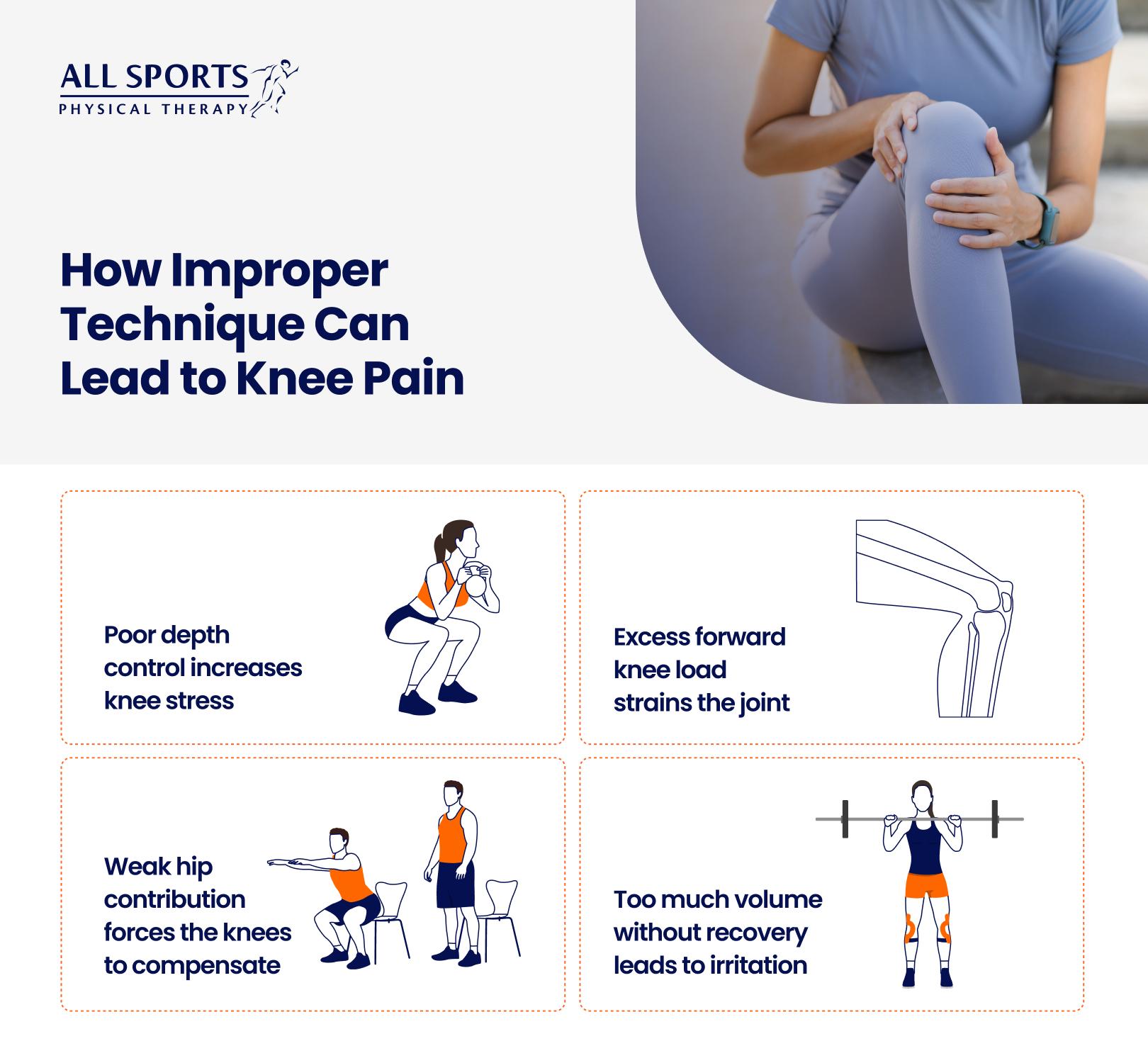
It cannot be emphasized enough: A painful knee when squatting can be traced to poor squatting technique. To perfect your form, avoid these common mistakes as you perform a squat.
- Depth control issues. Inconsistent or poorly controlled depth movement as you go up and down shifts more of the load to the knee. The motion should be controlled and steady. One common miscue while reaching depth is known as the “butt wink,” or rounding your back at the bottom of the squat, causing your knees to move inward.
- Poor knee alignment. Align your knees with your feet, never too far forward or behind them. Knees collapsing inward also causes the joints to absorb more of your weight.
- Limited hip contribution. Though squats are a “knee-centric” movement, your hips play a role, too. Weak hip muscles or improper hip posture force more load on the knees. Be sure to move your hips backward as if you’re going to sit in a chair as you squat.
- Foot and ankle mechanics. Knee pain while squatting can frequently be attributed to ankle and foot instability or poor mechanics. The proper foot form when squatting is dorsiflexion, or when the top of your foot nears the front of your leg. In addition, if the ankle is restricted or doesn’t have full function, your knee loses support during the squat.
Why Sudden Sharp Knee Pain Can Happen During Squats
A sudden sharp pain in the knee can happen when squatting, along with a pulling sensation. It doesn’t necessarily mean a serious injury. It could be a temporary overload on the joints and muscles. The jolt of pain could be your body telling you to take a break from squatting, let up on the weight volume, and give your body time to rest.
Yet it’s also important to listen to your body when it sends pain signals. It might be because of an underlying knee condition that can be effectively addressed with treatment.
- Patellofemoral pain syndrome. Pain at the front of the knee due to misalignment or overuse of the kneecap.
- Patellar tendinitis. An inflammation of the tendon connecting the kneecap to the shin.
- Knee osteoarthritis. Degeneration of cartilage leads to joint stiffness, pain, and reduced range of motion that intensifies when squatting.
- Meniscus tears. The cushioning inside the knee joint tears, causing knee pain when you squat.
When Knee Pain From Squats Is a Warning Sign
Knee pain while squatting may be common, but it shouldn’t be ignored, either. The symptoms listed are not an indication of a serious injury. More often, they simply mean you need further evaluation to understand what is causing the knee pain when squatting and how to take care of it.
- Immediate and intense swelling after squatting
- Pain that persists outside workouts
- Feeling of instability, catching, or the knee giving out
- A sudden “popping” sensation in the knee
- Progressive worsening despite reduced load
- Inability to do everyday tasks, like climbing stairs
How to Fix Knee Pain From Squats
The good news is, improving your squatting form is the easiest way to maintain healthy knees. Strengthening and stretching exercises are important, too.
Improve your technique. Simple tweaks to your squatting form can lift the stress off your knees:
- Stand with your feet about shoulder/hip apart with toes pointed slightly outward.
- Bend at your knees and push your hips back.
- Keep most of your weight in your heels as you go through the squatting motion.
- Hold this position while you focus on squeezing your thigh and hip muscles.
- Push through your feet to straighten your knees and return to a standing position.
Focus on building strength. The key is to build strength gradually. Start with squats using only your body weight. Add weight as you become stronger.
Improve mobility in hip and ankle. Combine strengthening exercises with stretches targeting the hamstrings, quads, and hips to support the knee. Boost ankle mobility by focusing on the gastrocnemius and soleus muscles of the calf.
How Physical Therapy Helps Improve Squat Mechanics
Don’t give up squatting because of knee pain. A physical therapist can fix knee pain when squatting by a detailed assessment of your squatting technique and other factors.
- Analyzing where you form is off track and how to correct it
- Identifying why the knee joint is experiencing excess pressure or load
- Building strength and control in the muscles supporting the knee joints
- Helping you progress back to safe squatting
Squat With Confidence!
Squatting isn’t only for hard-core athletes. Every time you sit in a chair or pick up an item from the floor you’re squatting. Such a natural motion should not cause discomfort. But when it does, the physical therapy team at All Sports Physical Therapy can evaluate your squatting technique and muscle strength to find ways to make squatting painfree. We’ll craft a comprehensive plan that includes physical therapy, massage, and other methods. Contact us today to learn more.
FAQs
Why do my knees hurt when I squat?
Most likely because you’re using the wrong technique. Proper squatting distributes the weight load evenly across several joints and muscle groups. If not, the knee takes the brunt of the body’s weight and feels painful.
Is knee pain from squats dangerous?
Because knee pain when squatting is common, many fitness experts warn people off of the exercise. But it’s not the squat itself that is dangerous. It’s squatting incorrectly that’s causing the knee pain.
What causes sudden sharp knee pain when squatting?
A sudden jolt of pain when squatting may not indicate a serious injury. It could be your body telling you to take a break. Yet any pain should be checked out by a medical professional to determine if there is an underlying reason for the knee pain that can be treated.
Should I stop squatting if my knees hurt?
Not necessarily. Squats can manage joint pain and it’s always good to stay active. But you might want to lower the weight, lower the depth of the squat, or try less strenuous squats, like wall squats. And you can consult with a physical therapist if the knee pain interferes with your daily activities.
Can physical therapy help fix squat-related knee pain?
Absolutely! A physical therapist can pinpoint where your squatting technique is stressing your knees and suggest adjustments. A physical therapist can also recommend strengthening and stretching exercises for the muscles around the knee to add extra support to the joint.